Digital safety advocate and founder of Safe Tayo? Philippines
Cybersecurity and technology risk professional with 13+ years of experience in technology, public service, and information security. Founder of Safe Tayo? Philippines, an independent digital safety and technology literacy initiative.
Philippines
On this page
Highlights
13+ years of professional technology experience
DICT Cybersecurity Professional Recognition, Level 3 – Expert
Master of Technology Management, University of the Philippines Diliman
Founder of Safe Tayo? Philippines
Professional experience across government and financial technology
International cybersecurity, AI, and internet governance programs
Technical cybersecurity certifications and technology governance experience
About
I’m a cybersecurity and technology risk professional based in the Philippines, with more than a decade of experience in technology, public service, and information security.
My work has covered IT risk management, cybersecurity governance, incident response, technology policy, systems development, and digital transformation. I spent more than 12 years in government before moving to the financial technology sector.
Outside my professional role, I founded Safe Tayo? Philippines, an independent initiative that makes cybersecurity, privacy, AI, and digital safety easier to understand for everyday Filipinos.
As a queer technology professional, I am particularly interested in how technology can better serve and protect people, including communities that are often overlooked in its design and governance.
My interests go beyond cybersecurity into responsible AI, digital rights, internet governance, technology resilience, and public-interest technology. I believe technical expertise is most valuable when it turns into something people can understand, access, and use.
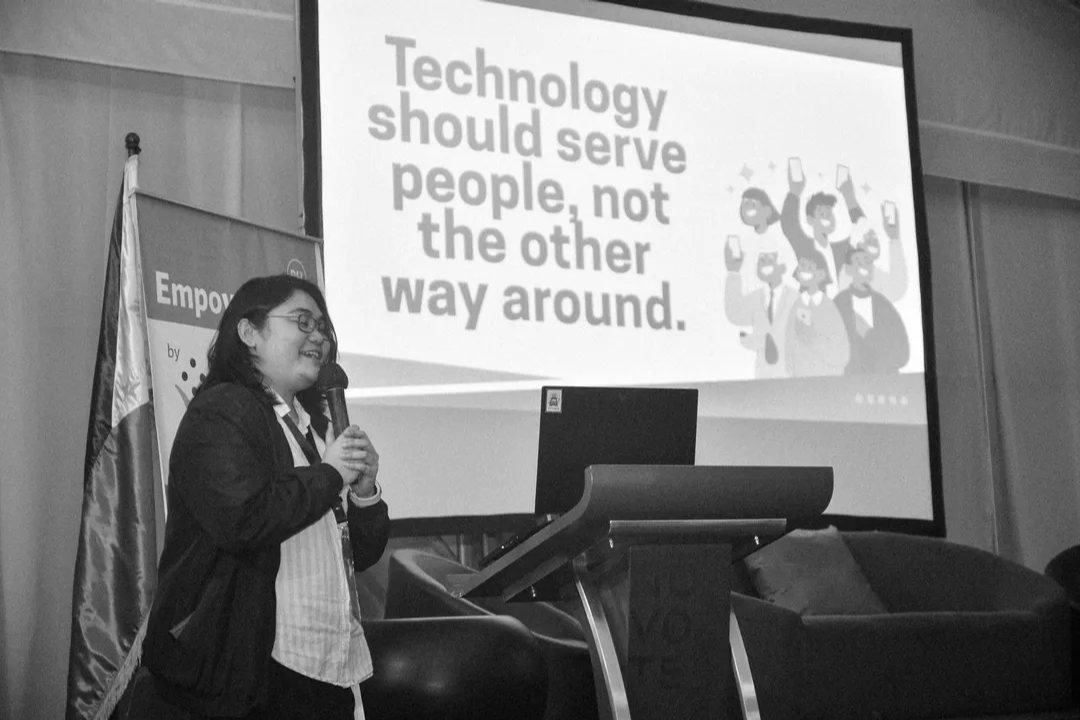
Technology should serve people, not the other way around.
Projects
Safe Tayo? Philippines
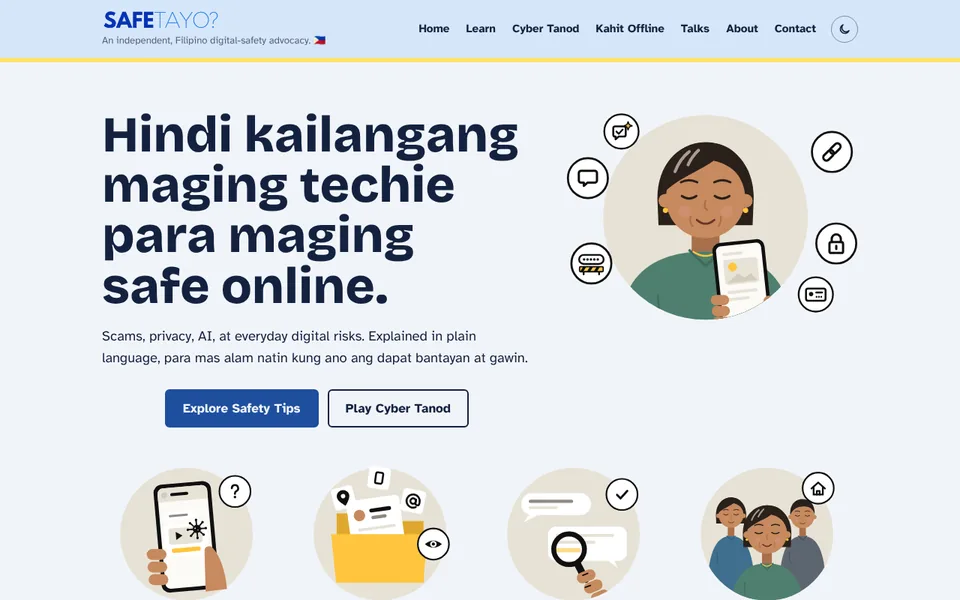
Making sense of our digital lives, one question at a time.
Role: Founder and independent developer Area: Digital Safety, Public Interest Technology
An independent digital safety and technology literacy initiative that connects technical knowledge to everyday digital life.
Filipinos rely more and more on digital services, but approachable cybersecurity and technology education is hard to find. Many existing resources are too technical, hard to access, or built on fear-based messaging.
Approach
Explain technical concepts in plain language, with familiar Filipino situations.
Produce practical resources in English and Filipino/Taglish.
Encourage informed decisions instead of fear of technology.
Write for people with different levels of technical knowledge.
Publish across several formats and platforms.
Content formats
Safe Tayo? Original
Safe Tayo? Tips
Safe Tayo? Explained
Digital Literacy 101
Interactive educational tools
Downloadable learning resources
Intended audience
Everyday Filipino technology users
Students and young adults
Parents and families
Older adults
Non-technical professionals
Career shifters
Communities with limited access to technical education
Cyber Tanod
Role: Creator and developer Area: Educational Technology, Gamified Cybersecurity Learning
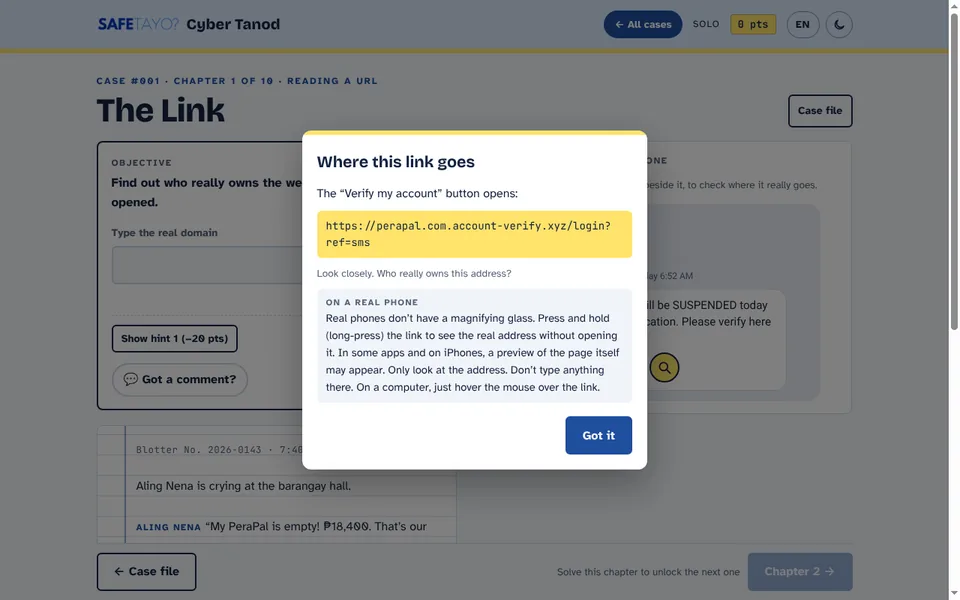
A browser game where players act as a barangay’s first “Cyber Tanod” and solve fictional scam cases by reading the evidence correctly. The game currently has four quests, rated Easy to Expert, plus a six-level Cyber Literacy Path.
Most cybersecurity awareness material asks people to read or watch. It rarely gives them practice making the actual decision: is this link, page or message safe?
Approach
Each chapter teaches one skill, and the chapter can only be solved by using it.
All brands, people and websites are fictional, so nothing in the game can be lifted as a working phishing template.
English interface with Taglish story and lessons, with a full English option.
Features
Scenario-based chapters with evidence to inspect
Fictional scam investigations set in Filipino communities
Difficulty that grows from quest to quest
Story-driven cases
Cyber Literacy Path
Facilitator-led live games
Host mode: players join with a 6-digit PIN on their own phones
Works in a mobile browser
No account needed
Intended audience
Students
Educators
Families
Community organizations
Non-technical users
Anyone learning cybersecurity basics
Design philosophy
Make cybersecurity learning approachable and hands-on, without assuming technical knowledge.
Kahit Offline: digital preparedness library
Role: Creator and developer Area: Digital Resilience, Community Preparedness
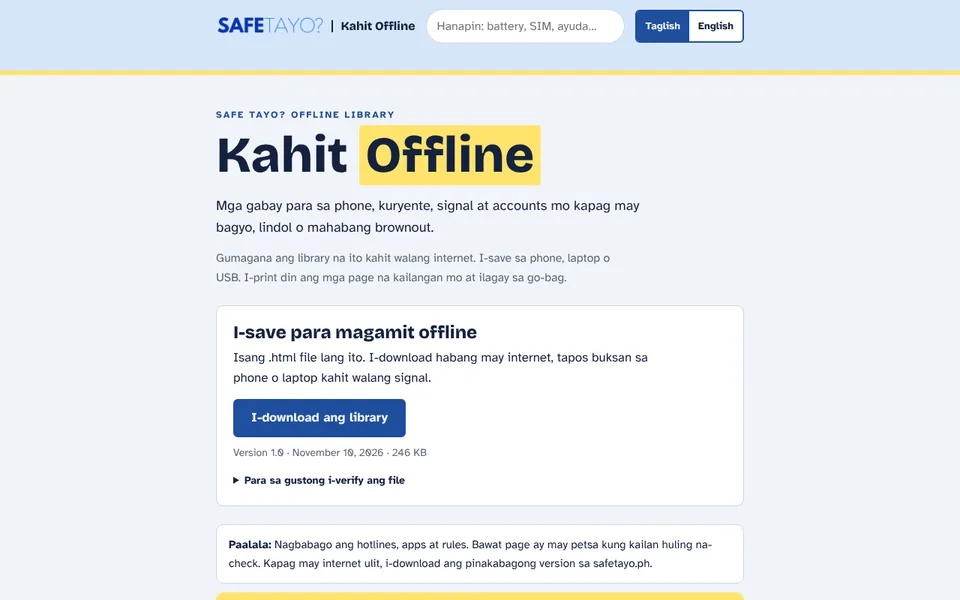
Preparedness guides for phones, power, signal and accounts during typhoons, earthquakes and long brownouts, packaged as a single file people can download in advance and open without internet.
The Philippines is often hit by natural disasters and connectivity outages. Useful digital information can become unreachable exactly when people need it.
Approach
Offer the library as one .html file to download while there is still internet.
Make it work on a phone or laptop with no signal, and printable for a go-bag.
Show when each page was last checked, since hotlines and rules change.
Available in Taglish and English.
Focus
Digital resilience, accessibility, preparedness, and continued access to information.
Safe Tayo? Explained
Role: Creator and educator Area: Technology Literacy, Public Education
A short-video series that introduces technology concepts to people with little or no technical background. Beyond cybersecurity awareness, it explains how digital systems actually work.
Break technical topics into small explanations that assume no prior knowledge.
Intended audience
People interested in technology
Career shifters
Students
Non-technical professionals
Anyone who wants to understand the technology they use every day
Experience
May 2026 – Present
Manager, IT Risk Management
G-Xchange, Inc. Financial Technology
Technology risk management in the financial technology sector: identifying, assessing, and communicating technology-related risks.
Areas of responsibility
Technology and cybersecurity risk assessments
Evaluation of technology controls and supporting evidence
Risk assessment of internally developed systems and third-party technology services
Emerging technology and cybersecurity risk intelligence
Regulatory intelligence and technology governance
Technology resilience and operational risk
Communicating technology risk to management and stakeholders
Cross-functional work with technology, cybersecurity, business, and risk teams
Nov 2013 – Apr 2026
Information Technology Officer I
Insurance Commission, Philippines Government / Financial Services Regulation
More than 12 years in public service, supporting government digitalization, information systems development, technology project management, cybersecurity, and institutional governance.
Selected work
Information security governance: Contributed to information security policy development, cybersecurity governance initiatives, and institutional incident response coordination.
Internal quality audit: Head of internal quality audit activities in 2025, supporting institutional process evaluation and quality management.
Areas of responsibility
Information systems development and maintenance
Database and application management
Technology project management
Government digital transformation
Information security governance and policy development
Cybersecurity incident response coordination
Computer Security Incident Response Team point of contact
Internal quality management and audit activities
Coordination with internal and external stakeholders
Translating regulatory and operational requirements into technology solutions
2026 – Present
Founder
Safe Tayo? Philippines Independent digital safety advocacy initiative safetayo.ph
Founded an independent initiative that makes cybersecurity, digital safety, privacy, AI, and technology literacy easier to understand for Filipinos, by turning technical concepts into practical resources for people without technical backgrounds. Developed and maintained independently, alongside my full-time role, and not affiliated with or endorsed by my employer.
Areas of responsibility
Public cybersecurity education
Digital literacy and technology literacy
Privacy and online safety awareness
Responsible AI education
Educational content development
Gamified cybersecurity learning
Accessible web-based educational tools
Offline-first digital preparedness resources
Public-interest technology advocacy
Recognition
Cybersecurity Professional Recognition, Level 3 – Expert
Department of Information and Communications Technology (DICT), Philippines, 5 October 2026
Professional recognition awarded through the DICT Cybersecurity Professional Recognition Program’s assessment process.
Selected through an application process for an initiative on AI, gender equality, and inclusive technology. Associated initiative: SiklabAI.
Themes: Responsible AI, Gender-inclusive technology, AI literacy, Ethical technology development
Data governance program
UNDP, UNESCO and ITU, 2025
Completed an international learning program on data governance.
Themes: Data governance, Responsible data use, Digital governance, Public policy
SWITCH! Program, Fellow
APNIC, 2024
Fellow in an initiative supporting gender diversity and inclusion in the internet ecosystem in Southeast Asia.
Themes: Internet governance, Gender diversity, Digital inclusion, Internet ecosystem development
Security Training Scholarship
Women in CyberSecurity (WiCyS), 2023–2024
Selected for a cybersecurity training scholarship supporting professional development and technical cybersecurity education.
Government Chief Information Officer Scholarship
Department of Information and Communications Technology (DICT), Philippines, 2021
Scholarship supporting professional development in government technology management and governance.
Women’s Leadership Program
Toronto Centre, 2024
Training and coaching program for women in managerial and supervisory roles at financial sector supervisory and regulatory agencies. Featured as a participant in the Toronto Centre Annual Report 2024.
ISO/IEC 27001:2022 Lead Auditor, Certificate of Competency
Mastermind Assurance, 2025
Training and skills-based examination, 16 credit hours. Valid until August 2028.
Expertise
Technology Risk and Governance
IT risk management
Technology risk assessment
Technology control evaluation
Third-party technology risk
Cybersecurity governance
Information security policy
Emerging risk intelligence
Regulatory intelligence
Technology resilience
Operational resilience
Cybersecurity
Incident response
Cybersecurity fundamentals
Web application security
Vulnerability assessment
Security awareness
Cybersecurity education
Cybersecurity incident coordination
Security control assessment
Technology and Digital Transformation
Technology project management
Systems development
Application and database management
API-based systems
Government digitalization
Technology management
Process improvement
Quality management
Public Interest Technology
Digital literacy
Digital safety education
Educational technology
Accessible technology communication
Gamified learning
Digital preparedness
Community-oriented technology development
Interests
Areas I follow and want to contribute to. These are interests, separate from the professional expertise listed above.
AI governance and responsible AI
AI safety and security
Digital rights
Internet governance
Technology policy
Digital inclusion
Public-interest technology
Cybersecurity education
Technology resilience
Data governance
Gender-inclusive technology
Digital safety for marginalized and underserved communities
Financial technology risk
Human-centered technology governance
Community
Digital safety and technology literacy
Through Safe Tayo? Philippines, I develop educational resources and interactive tools that help people understand and navigate technology more safely.
Gender inclusion and digital rights
I care about building safer and more inclusive digital spaces, especially for communities that face barriers to participation, representation, and access. My time in the UN Women Asia-Pacific AI School and APNIC SWITCH! shapes this work.
Queer Safe Spaces
Vice Chair, November 2019 to March 2026. Queer Safe Spaces partnered with the UP Technology Management Center on a 2022 webinar on gender sensitivity and cybersecurity hygiene, where I spoke.
Civic participation
Recurring local volunteer with the Parish Pastoral Council for Responsible Voting (PPCRV), supporting election-related civic participation.
Speaking & writing
AI for Public Good
Speaker at EmpowerTech Philippines, November 2025
Discussed the role of artificial intelligence in serving the public good, with an emphasis on people-centered technology, responsible AI, and inclusive digital development.
Role of Cyber Hygiene in Online Safe Spaces
Webinar speaker at Empowered and Cybersafe Digital World: A Gender-Sensitive Approach for a Technology-Driven Society, organized by UP Technology Management Center, in partnership with Queer Safe Spaces, November 2022
Gender sensitivity and good cybersecurity hygiene. Held in observance of the 18-day Campaign to End Violence Against Women and their Children.
Collaboration & contact
I’m interested in connecting with people and organizations working on cybersecurity education, digital rights, responsible AI, technology governance, and public-interest technology.
I’m open to:
Research and knowledge exchange
Digital safety education
Community-based technology initiatives
Speaking engagements and workshops
International fellowships and professional exchanges